
Professional Book Indexing Services
An index is one of the most useful tools a reader can have. It allows them to locate specific ideas, revisit important concepts, and navigate your book in a way that makes sense to them — not just in the order it was written.
A strong index does more than list keywords. It organizes information, connects related ideas, and reflects how readers actually search for content. Done well, it increases the usability and long-term value of your book.
Indexing is a specialized skill that requires careful judgment, attention to detail, and experience. A strong index doesn’t just list terms — it organizes ideas in a way that makes sense to the reader.
How Indexing Works
Indexing usually takes place at the final stage of the production process, after formatting is complete and pagination is set.
The process involves:
reading and analyzing the manuscript
identifying key topics, names, and concepts
grouping related ideas into clear entries and subentries
creating cross-references where helpful
organizing everything into a structured, alphabetized index
Each index is tailored to the content and audience of the book. The goal is always to make it intuitive for the reader — not just technically correct.
By default, I index following widely accepted publishing standards (such as Chicago Manual of Style), but I can adapt to your preferred format if you or your publisher have specific guidelines or examples.
Before You Start
Indexing depends on a stable layout.
If your book is still being edited or formatted, it’s best to wait until pagination is finalized before beginning.
If you’re still preparing your manuscript, I also offer editing, formatting, and full publishing-prep packages, so everything can be handled in a coordinated workflow.
Pricing
Indexing is priced by indexable page, meaning any page that contains content to be indexed.
While each book is different, these ranges give a general idea:
General nonfiction / business — $3.00–$3.50 per page
Academic — $3.25–$3.75 per page
Technical / dense material — $3.50–$4.50 per page
For example:
A 180-page book with 150 indexable pages may fall in the range of $450–$700, depending on complexity.
Final pricing is always based on the specific manuscript.
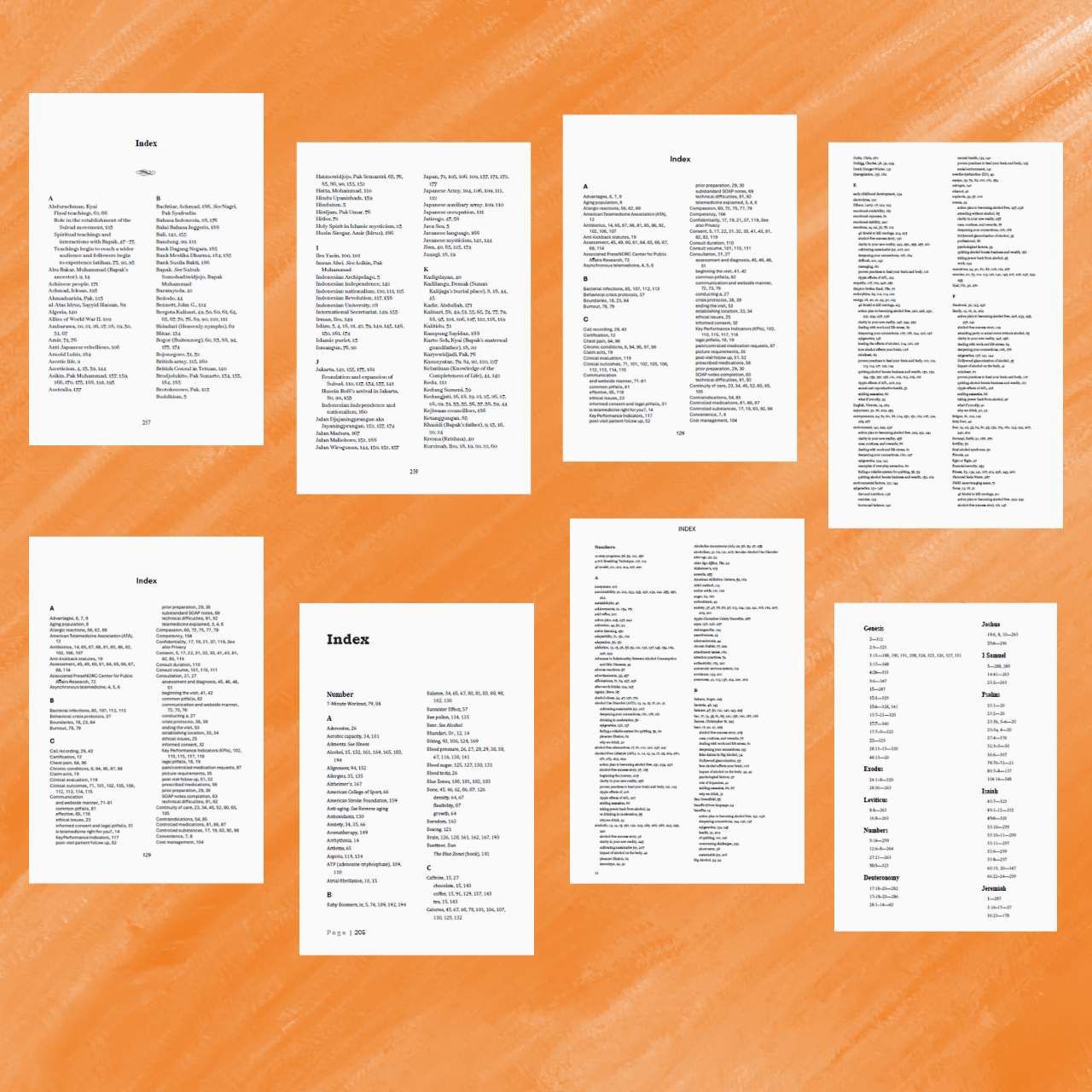
Types of Indexes
Back-of-the-Book Index (Static)
This is the most common type of index and is created from your final, formatted manuscript.
It relies on fixed page numbers, so it’s prepared once your layout is complete and pagination will no longer change. Each entry points the reader directly to the exact page where the topic appears.
You’ll receive the index as a clean, formatted Word file that can be placed into your book during final production.
Best for: books that are finalized and ready for print or distribution.
Embedded (Live) Index
An embedded index is built directly into your manuscript using index markers (codes).
Because the index is built into the document, it can be regenerated if pagination changes. This makes it a good option for books that may be revised or expanded later.
Best for: books that will be updated, revised, or maintained over time.
Note: Embedded indexes require more time and are typically 20% higher in cost due to their complexity.
Your Questions, Answered
-
What You Receive
A structured, easy-to-use index tailored to your book
Clear entries and subentries that reflect how readers search for information
Consistent terminology and thoughtful organization
A final file ready to insert into your manuscript
Optional embedded index if requested
The focus is always on usability — helping readers find what they need quickly and naturally.
-
Not all books require one. Indexes are most useful for nonfiction, academic, technical, and reference books where readers may need to locate specific information quickly.
-
For standard indexes, pagination must be final. Embedded indexing can sometimes be done earlier, depending on the workflow.
-
That depends on the book and your goals. Some indexes are simple and concise, while others are more detailed with layered subentries. I adjust the depth based on the content and audience.
-
Yes. I follow standard publishing practices by default, but I can adapt to your requirements if you provide guidelines or a sample.
-
Several factors influence the scope of an index:
how complex or technical the subject matter is
how densely information is packed on each page
the number of terms, names, and concepts that need to be indexed
whether there are tables, figures, or specialized elements
the level of detail required (simple vs more in-depth indexing)
formatting preferences or non-standard structures
whether multiple indexes are needed (e.g., subject + name index)
turnaround time
Because of this, each project is quoted individually
-
Final manuscript
PDF for back-of-the-book index
Word file for embedded index
Confirmation of index type (static or embedded)
Any style preferences or examples (optional)
Your timeline or publication date